

How To Draw A Star With Cute Eyes
I've resisted writing this kind of post for a long time. In my experience, the type of instructional content plant in countless books, blogs and YouTube videos with titles like How To Draw '10' is usually oversimplified and misleading.
There are 2 reasons for this. First, when y'all describe a portrait, things like the model's individual morphology, our perspective equally the viewer, and the lighting environment are different in every case, and can greatly affect your decisions. Drawing well is usually more complicated than only following a listing of formulaic steps that don't take variables into business relationship.
2d, thinking in terms of "how to depict eyes" – as if the optics are somehow privileged and divide from the rest of the face, head and torso – breaks upwardly the effigy into artificial categories. In truth, in that location's as much structure to be observed on the model'southward cheek or forehead as in the eyes, but we tend to be unaware of that (at that place aren't many "How to Draw Foreheads" tutorials out there). Instead, nosotros focus on "optics", "olfactory organ" and "mouth" too much, and forget about everything else. Manufactures like this make me queasy because they seem to reinforce this way of thinking.
Nevertheless, drawing convincing eyes is something a lot of students struggle with, often unnecessarily. We tend to approach the eyes in our drawings with lots of anxiety because they're psychologically important to homo beings. It'south also where we wait first in a portrait. Mess up the eyes, and you're all of a sudden stuck with a "bad drawing", while the aforementioned degree of error in describing the neck or chin may go unnoticed past most viewers. It's not fair, simply it'due south the way it is.
In this post, I'll lay out the things I think most almost when drawing eyes on a portrait. I'll try to take some variables into account, but remember these instructions are not universal. There will exist plenty of times while drawing a model when you lot'll encounter bug not mentioned here. But that's what learning to draw portraits is like. As similar as human beings are to one some other, there's still no ane-size-fits-all teaching set for cartoon eyes – or annihilation else. The way forwards is to blot what you can from teachers you trust, only be prepared to accommodate and improvise every bit you run into unique problems… considering you will.
And so, let's get started.
Big Things First
This is practiced advice for cartoon any discipline, not just optics, because it's easy to become bogged down in details when drawing something complicated. Eyelashes, wrinkles and subtle highlights are all fun to draw, merely are zippo simply distractions early (ones I still succumb to from fourth dimension to time). Every bit students who've taken online courses at Vitruvian Studio already know, it'due south always advisable to work from "general" to "specific" while cartoon. In other words, constitute the biggest, broadest shapes showtime, then subdivide them to arrive at the smaller, more specific characteristics.
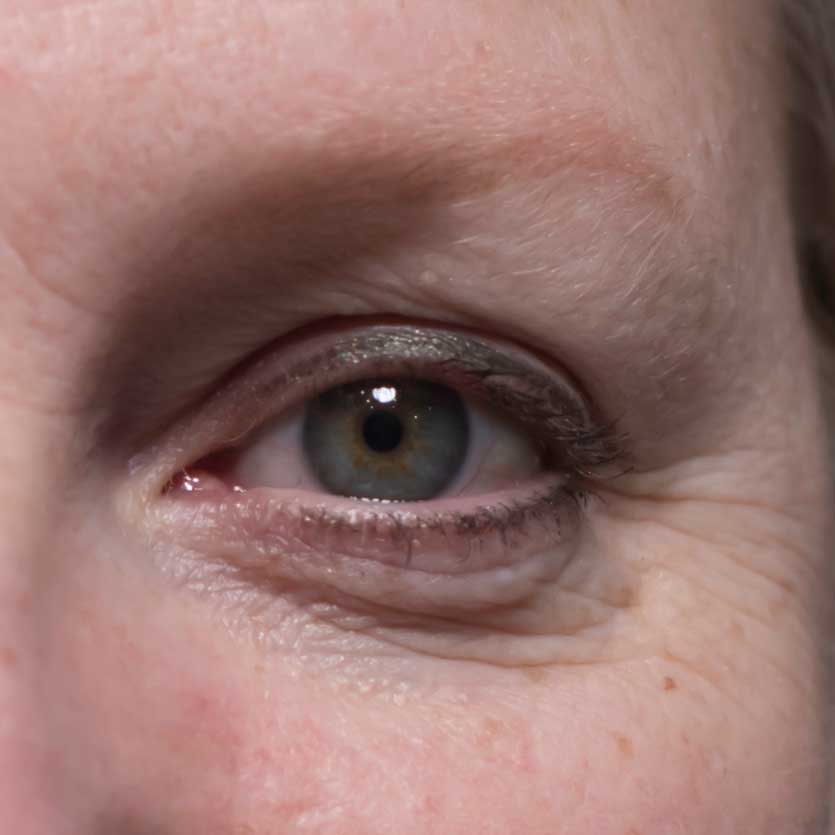
Context is Important
You lot don't take to be a comedian to know that when telling a joke, you can't only jump to the punchline. You take to "prepare information technology up" first. If yous don't, fifty-fifty the funniest joke in the earth won't quite work.
The aforementioned principle applies to drawing.
The biggest problem with most "how to draw eyes" tutorials is that they jump also rapidly to cartoon… well… eyes – the eyelids, iris, pupil, etc – without get-go setting-up a structural context for the eye. In other words, eyes look the fashion they do in part because of everything that surrounds them.
This means that nosotros need to wait across the boundaries of the middle itself to consider the broader eye region, including the bony structures of the forehead and forehead, the cheekbones, and the nose.
1: Build the Middle Socket
The eyeball is gear up deep within a crenel in the skull called the "orbit" – or more unremarkably, the "centre socket". Each centre socket on the skull is bordered visually by 3 bones:
- The Frontal Bone across the tiptop, forming what's called the "brow ridge"
- The Maxilla along the inside (medial) border and the lower medial corner
- The Zygomatic Basic, or cheek bones, forth the outside (lateral) border and lower lateral corner
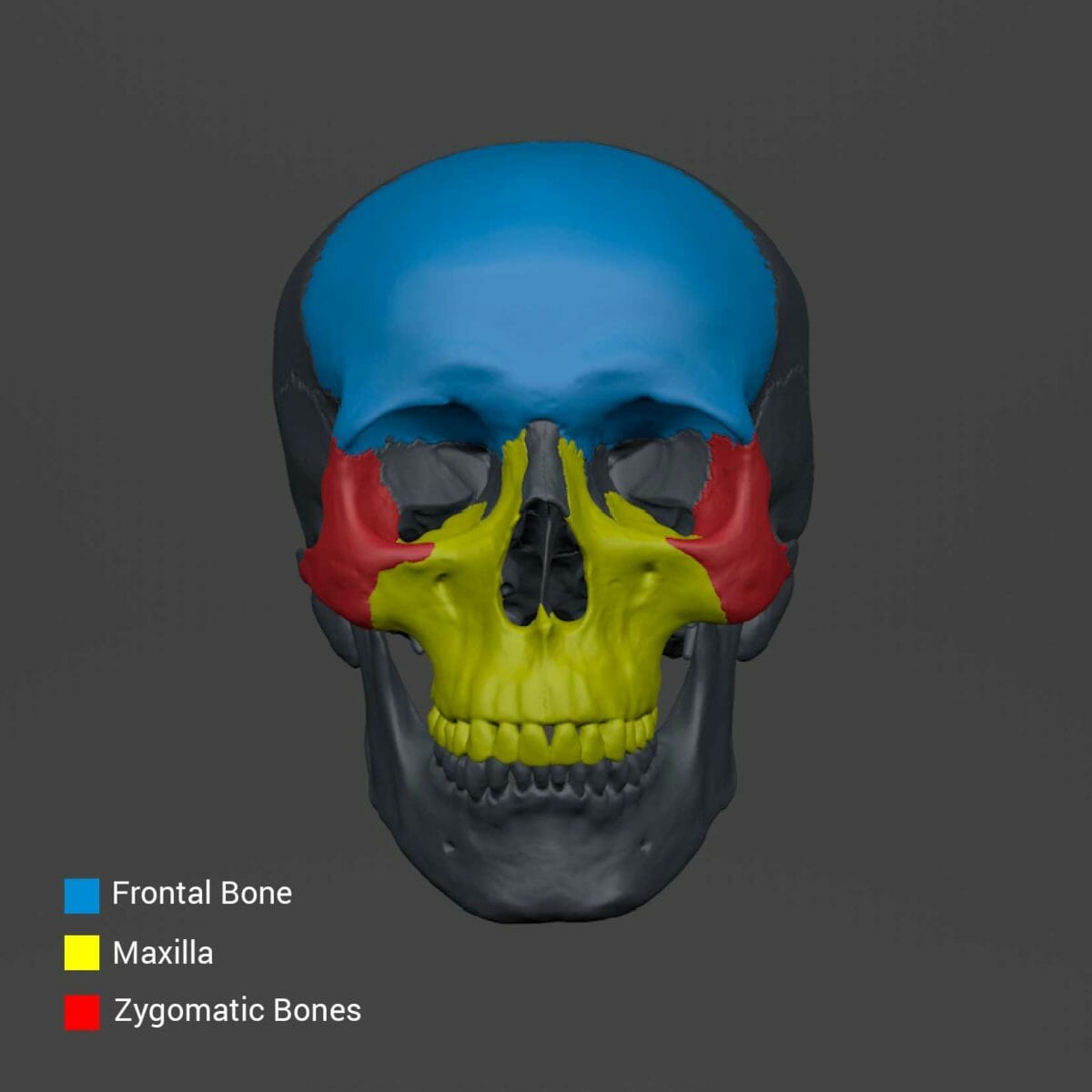
(In the front view, the nasal basic may announced to border the eye socket, only they're actually set quite far forwards of the orbital cavity, so I haven't listed them here.)
These three bones are what requite the eye socket its characteristic shape, which in the front view isn't really circular, but more of a rhomb with rounded corners.
Starting with an HB pencil, lightly mark the boundaries of the eye socket on the page. Looking for certain landmarks will assistance you practise this:
- The eyebrow: While information technology doesn't marking the superlative of the socket (that sits lower), the eyebrow is useful because it's often piece of cake to run across and information technology marks a plane modify where the brow ridge begins to decline and in toward the eye socket.
- The supraorbital margin: this is the actual top border of the socket itself, and is often marked past a deep pucker at the top of the upper lid, where it folds on itself as it rolls up and under the brow ridge, like a retractable awning. This sharp definition is sometimes seen downwards the lateral side likewise, along the upper office of the zygomatic bone. (Due to the centre cover fold, this pucker isn't visible on individuals of asian descent.)
- The inner canthus, or "tear duct" at the inside corner of the eye, marks the medial (or inside) border of the centre socket.
- The infraorbital furrow marks the bottom boundary of the socket, and is often seen on the surface as a soft ridge running downwardly and laterally from the inside corner of the eye. Its trajectory echoes that of the forehead ridge to a higher place information technology.
Keep information technology light! These lines are only placeholders that you lot'll probable desire to remove later. Don't nail them in! Draw lightly with the shoulder of the pencil pb to avoid gouging your paper.
2: Block-in the Shape and Position of the Eyelids
When blocking-in the eyelids, recall that they're stretched around the eyeball beneath them, which largely determines their shape. The trajectories of the lids equally they arc across the eyeball are essentially cross-contours on a sphere – like lines of latitude on a world. On the eye, these trajectories aren't perfectly elliptical because they get pushed effectually by the cornea on the eyeball and the bony structures of the socket. Even so, the eyeball is basically round, and that roundness is the biggest influence on the shape and path of the eyelids as they arc from corner to corner.
The squeamish thing nearly building the eye socket kickoff is that it helps us find the outer boundaries of the lids:
- The summit of the upper lid is defined by the top of the middle socket – the "supraorbital margin" – and follows its downwards-lateral trajectory.
- The lesser of the lower lid sits just above the infraorbital furrow at the bottom of the center socket, and likewise echoes its downwardly-lateral trajectory.
- The inside corner of the eye sits directly on the inside edge of the eye socket. We only need to make up one's mind how high or low it sits.
- The lateral corner of the eye is coincident with the supraorbital margin laterally every bit it turns downwards toward the zygomatic bone.
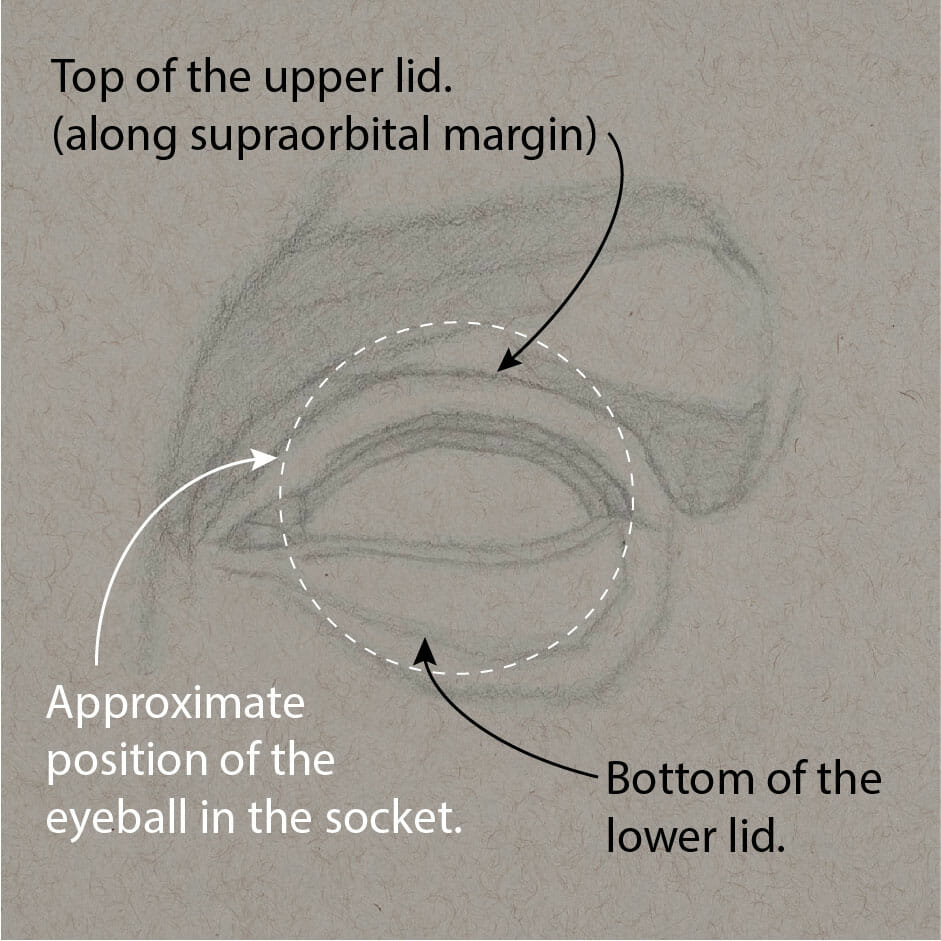
At this indicate information technology may be noticeable that the eyeball sits surprisingly high within the eye socket, being tucked up and nether the top of the supraorbital margin.
Annotation:
You may be wondering why I don't suggest cartoon the eyeball at this stage. Some tutorials abet this, and information technology makes a certain corporeality of sense. After all, the eyeball fills much of the heart socket nosotros only finished establishing, and is responsible for much of what we perceive as the shape of the heart, so its influence is important.
I don't suggest we draw the eyeball straight, however, because nosotros run into so trivial of it. Being mostly covered by the forehead ridge and eyelids, the precise size and position of the eyeball in the socket can be ambiguous at best. The trend is to draw the eyeball either besides big or too small, and likewise low in the socket, which can create problems for us downwards the road.
Instead, allow's proceed past blocking in the parts of the eye we can actually see (either straight or through their influence), starting with the larger, containing shapes. At this phase, with the heart socket already established, that means cartoon the eyelids.
The Orientation of the Heart
It's easy to presume that the eye, from corner to corner, sits horizontally on the head, just that'due south often not the instance. Ordinarily, ane of the two corners of the heart sits slightly college than the other.
This can vary between individuals and with your angle of view on the model, merely it's always worth checking. Imagine a straight line connecting the ii corners of the heart and determine its tilt. So try to replicate that angle on the page equally advisedly as you can.
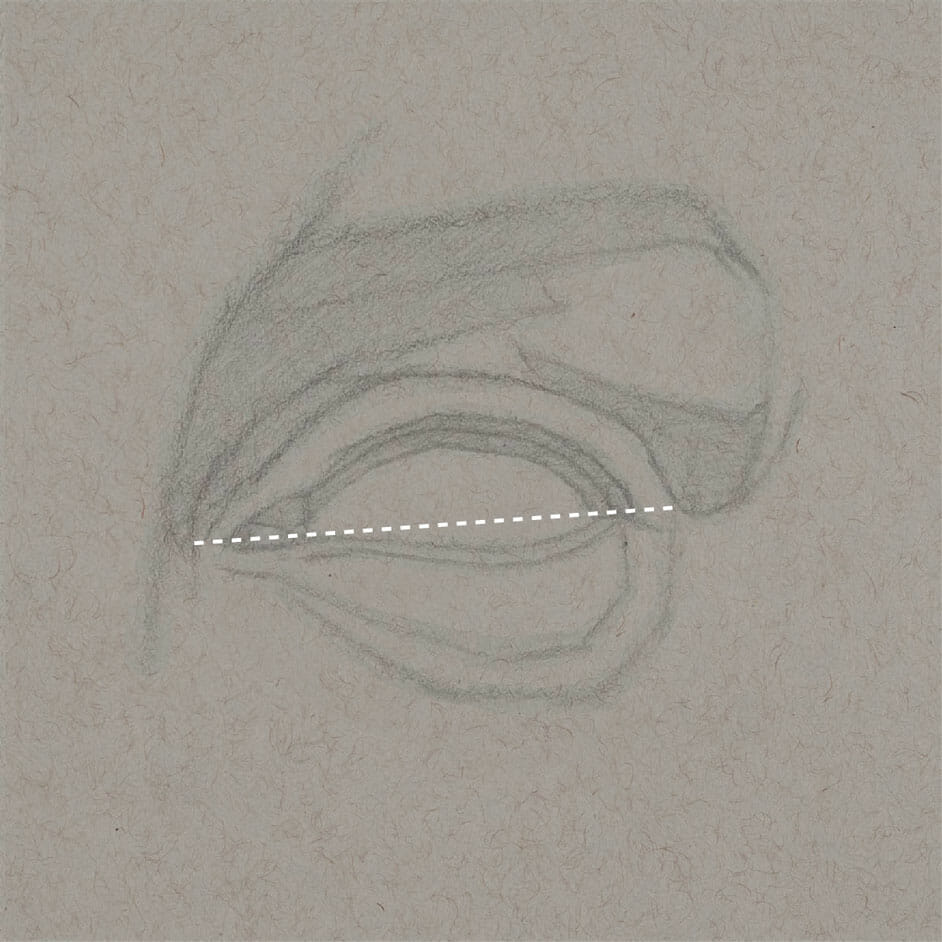
Well-nigh the Shape of Eyelids
The optics are not shaped like footballs or almonds. And yet, this is one of the nearly common mistakes made past students – and for that matter, many "how to draw eyes" tutorials.
While it's true that the opening between the lids tapers to a point on each side, that shape is also asymmetrical.
The Outer Boundaries:
Look for the "high bespeak" – or noon – of the curve of the upper lid and you'll find it sits somewhat medially (or toward the inside). This is because the form of the hat follows the path of the supraorbital margin, which is angled downward, laterally.
The Inner Boundaries:
The outer and inner purlieus of each eyelid repeat one another, simply they aren't parallel. The inner boundaries announced less curved when the optics are open up considering of perspective – they aren't rolled upwardly or downwards over the eyeball as much as the outer boundaries, which makes the curvature appear less amplified from our angle of view.
It'due south too important to annotation that in conventional portraiture, with a more-or-less eye-level view on the model, the upper lid oft appears more rounded and the lower chapeau "flatter" (this isn't always the case, but it happens oftentimes enough to be worth mentioning). The reason for this is simple. When the heart opens, the upper lid does well-nigh of the work, rolling up and over the eyeball, similar an awning. The lower hat stays relatively stationary. This means that the upper chapeau sits up on top of the eye when it is open, arcing up-and-over the round form of the eyeball, and thus actualization more rounded from our signal of view. The lower hat, by comparison, doesn't "curlicue down" very much, only rather pulls relatively straight across, appearing less curved from our bespeak of view.
The Eyelids Have Thickness
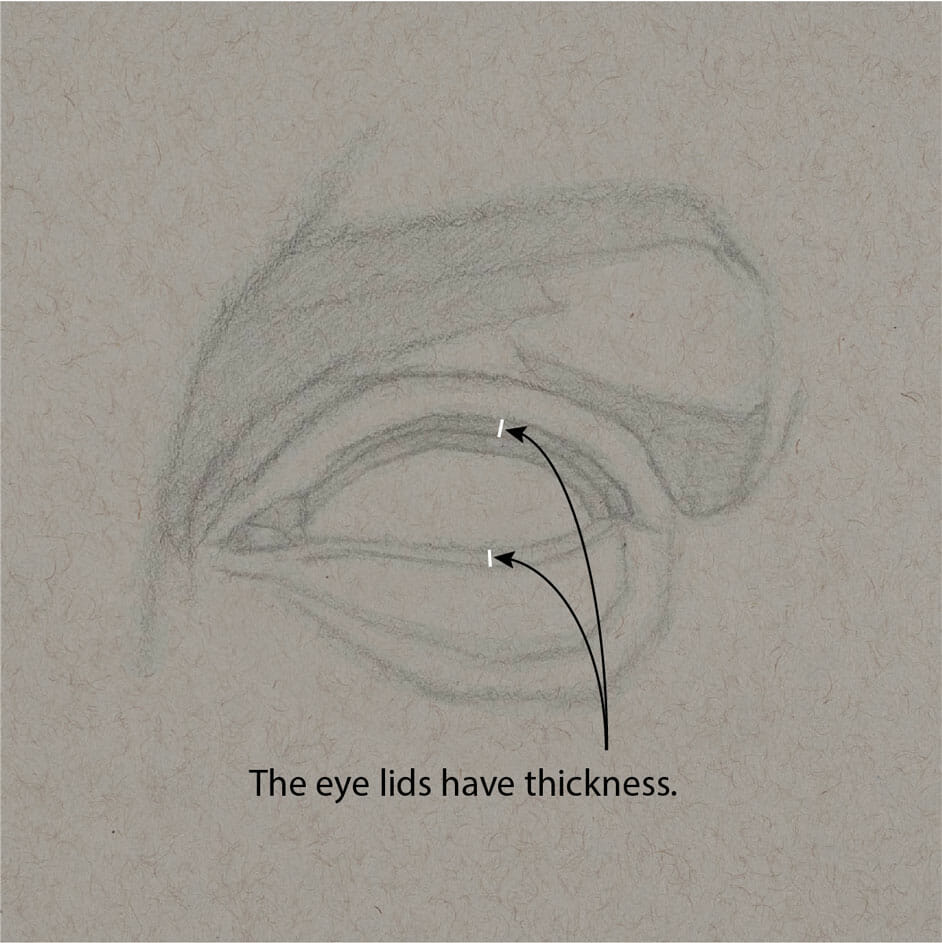
Fifty-fifty in a line drawing, a single line is often inadequate for describing the structure of each eyelid. This is because the eyelids accept thickness and nosotros can oftentimes see the top or bottom surface of the lids projecting outward from the surface of the eyeball. Including these planes in your drawing will help requite your eyes dimension, making the eyeballs appear relatively recessed into the eye sockets – which they are.
3: Adding the Iris and Pupil
With respect to drawing the concrete eyeball, there are four components we need to consider:
- The pupil is basically simply a pigsty in the eyeball allowing for the ingress of light.
- The iris is a pigmented disc that surrounds the educatee, featuring a complicated machinery that allows the aperture to expand or contract.
- The cornea is a raised, transparent dome-like structure that sits on peak of the student and iris.
- The sclera comprises the remaining surface of the eyeball and is what we normally refer to as the "white of the eye"
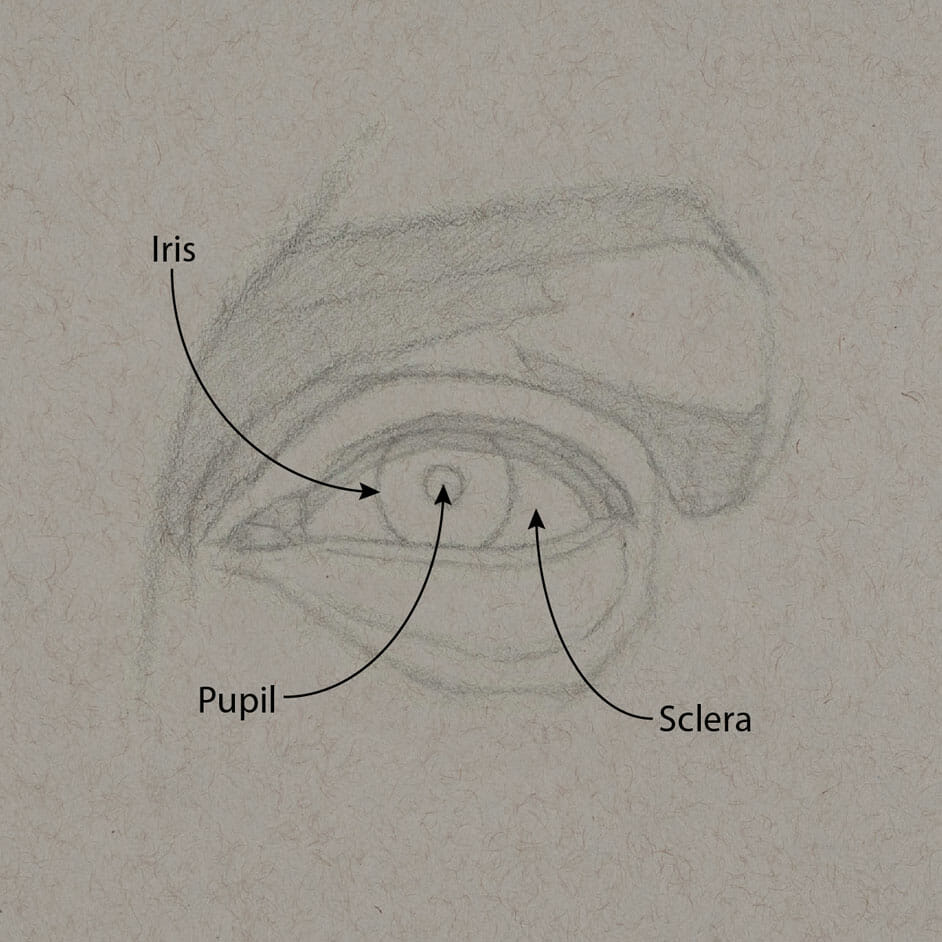
Calibration
Students often struggle with finding the appropriate scale for the iris and educatee. The tendency is to draw them too big, filling up likewise much of the space between the eyelids, which tin can make a portrait look infantile or similar an anime grapheme.
A popular rule of thumb is that the size of the iris is about ⅓ that of the whole eyeball. This is roughly truthful, but it's also catchy to apply. We don't see the full width of the eyeball because much of it is covered past the bones and eyelids, so determining ⅓ of that distance usually involves some guess piece of work. And so go on the thirds dominion in mind, only too try to observe the proportion of iris to sclera visible on the eye from your point of view. If the iris is as well big on your drawing, the space available for the sclera will be too small.
Shape
When viewing the eye from the front, the iris and pupil appear round… or at least close. You may occasionally observe on some individuals that these shapes aren't perfectly circular, but it'southward wise to describe them every bit circles anyhow. Otherwise, it may look like a weird drawing error.
If the model's gaze is turned away from yous, however, the circles of the iris and pupil volition become elliptical. For a comprehensive procedure for cartoon ellipses correctly, check out our Drawing Nuts course!
The Iris is a Calorie-free Saucepan
An important feature of the iris that's often overlooked is that it has depth. The outer rim of the iris sits flush with the surface of the sclera, but the inner discontinuity of the pupil is set somewhat inward. This gives the iris a noticeable "bucket" or "lampshade" structure (or "like the light amplification by stimulated emission of radiation canon on the Decease Star" as one student aptly put information technology.) This inverted shape has of import consequences for our lite and shade development, equally nosotros'll run into later.
The Cornea
Covering the iris and pupil is a transparent dome called the cornea, which assists in focusing light into the eye. Think of the cornea as being like a contact lens sitting on the front of the eyeball. It isn't directly visible because information technology'due south see-through, but it'south influence is: highlights seen on the eyeball frequently sit on the cornea, partially obscuring the iris and student, because the cornea projects forward.
This forrard project of the cornea besides has an influence on the shape of the upper eyelid. Depending on the management of the model's gaze, the lid may get pushed upward and outward over the "bump" of the dome-shaped cornea. This tin influence where nosotros perceive the loftier point of the upper chapeau to be as it arcs over the eyeball.
And At present The Fun Part: Light & Shade
With the linear structure established, it'southward time to transition toward low-cal and shade evolution. This is where we build upon the work we've done to make the heart appear convincingly illuminated and iii-dimensional.
You lot may accept already completed (or partially completed) he first pace toward this goal: drawing the shapes of the shadows. This helps u.s.a. in the linear stage in getting positions and proportions correct, but it's likewise how nosotros begin to indicate the different orientations of planes on the eye. If we do this right, we can create a rudimentary sense of form with just 2 values: one for the light side and 1 for the shadow. This binary argument is called a "poster".
Call back of the light masses and shadow masses as being like puzzle pieces – they should fit together perfectly. The edge between these puzzle pieces is what we call the "shadow border" or "terminator". The terminator is what nosotros're going to draw at this stage with a soft line as it bumps over the various forms of the middle region.
As you carve out the shapes of various shadows on and around the heart, hatch them downward lightly with an HB pencil. This will help you run across if your shadow shapes are correct.
A Note about Lighting:
This is the phase where poor reference material tin really cause you problems. A lot of studio photography uses multiple light sources with big diffusers to fill up shadows and make blemishes and wrinkles harder to run across. The issue tin can be flattering, but it's also flattening. Without any shadows, at that place's footling to tell your brain what planes are oriented in what direction, so creating the illusion of 3-dimensional form in your drawing is nearly impossible without lots of invention.
To solve this problem, depict from life when possible. If cartoon from life isn't an option, always inquire yourself this question when choosing a photo reference: "Where is the chief light source in this picture?". If you tin can't tell, keep looking for a improve photograph, or take 1 yourself!
4: Reference Values
Before showtime the full calorie-free and shade development on the middle (or on anything), we first need to set the range of values. This is important because "light" and "dark" are relative. We can only determine how light or dark something should exist in comparing to the lightest lite and darkest night. Nosotros call these "reference values". I liken the part of these values to that of the oboe when tuning an orchestra – all the music that is to follow is tuned relative to that.
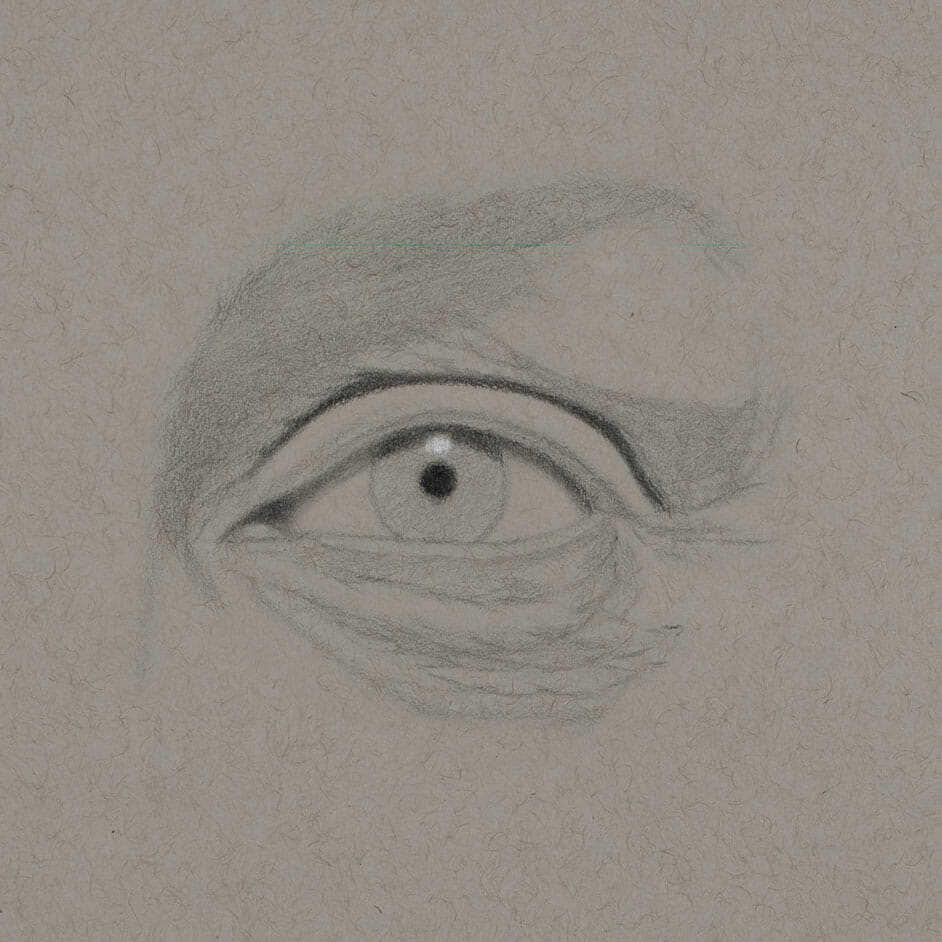
The darkest darks in the heart region are predictably institute in a few places (assuming the low-cal is traveling from above). The deep pucker of the upper lid along the supraorbital margin is 1 candidate. The student of the centre is another (assuming it'south non obscured by whatever reflections on the cornea).
The lightest lights are usually observed on the upward-turned surfaces of either lid, or possibly in a highlight on the cornea or sclera. Highlights are reflections of the calorie-free source, after all, and and then they tend to be quite vivid.
5: Tuning "Chords"
With the reference values in place, it'south time to begin "tuning" the values of nearby areas, carefully gauging the "interval" between different notes. This can be tricky to do well – at least if you're new to this idea – just here are a few tips to help you out:
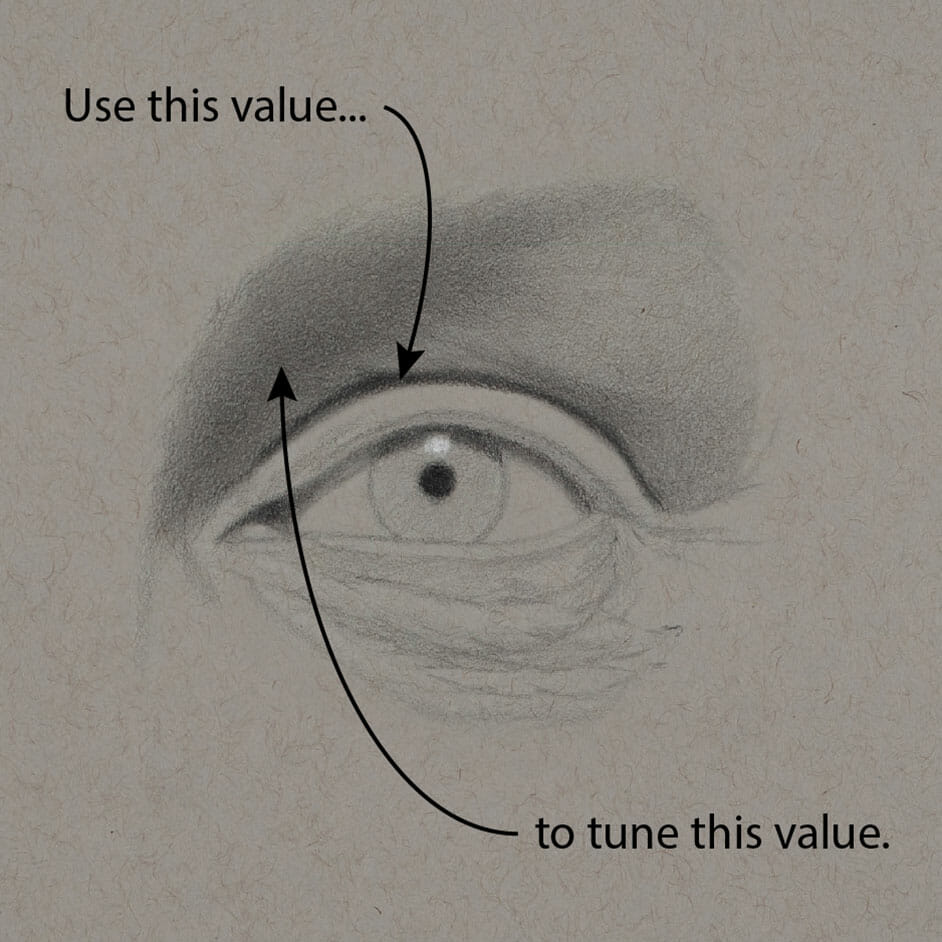
- Work side by side areas. Don't hop all around your cartoon at this phase. It's easier to judge value relationships when they're right next to each other.
- Tune small intervals first. It's easier to judge small intervals than larger ones. With the darkest dark established, await for the next darkest nearby value and develop that start.
- Piece of work across boundaries. Don't allow the names of things confine yous. If you're working in the iris/student area, be sure to develop nearby values on the sclera and the lids, likewise. Don't try to complete anything before you've integrated it with the surrounding value construction.
6: Modeling Forms
At this stage, your drawing may resemble a patchwork quilt, with a few clusters of different values tuned to each other. It's now time to begin organizing these apartment notes of value into progressions – or gradients – that get darker or lighter as the form turns abroad from or toward the principal lite source.
Call up that the eyeball is a sphere. The lids follow the curvature of that sphere as they arc across the center from one corner to the other, significant the orientation of these surfaces relative to the light source is constantly changing. In club for our cartoon to appear 3-dimensional, it's necessary to describe the "turning" of these surfaces with gradual changes in value running in dissimilar directions.
To some extent, this can be done visually – but compare your drawing with your reference and try to lucifer the value relationships you lot meet. But it's too necessary to consider the direction of the light. By this I mean thinking in a 3-dimensional way, considering the relative orientation of dissimilar planes to the light source. Assuming a consistent local value and distance to the low-cal source, surfaces that face the low-cal more directly should exist lighter than those the confront the light less directly. Being enlightened of this tin help convey value changes that you may non find visually – the divergence in value between 1 office of the form and another may be very subtle, but important nonetheless.
A good example of this tin can be seen on the iris. Remember the "bucket shaped" structure of the iris I referenced before? This has a big influence on the values nosotros use in this surface area because the planes are inverted. The lightest part of the iris is at the lesser where the surface faces upward toward the light, and the darkest part is at the meridian – exactly the opposite of what nosotros see on the sclera and the eyelids. The orientation of a given surface to the lite matters. A lot.
As yous develop your values, attempt to recall about "sculpting" the course as you get. This is why nosotros typically refer to this stage as "modeling" rather than "shading". The goal here is to uses gradients and progressions of value to gently "turn" the surface of the form up toward the lite (lighter) or down and abroad from it (darker). It tin assist to imagine while drawing that your pencil is a tiny clay tool, pushing and pulling the surface of a little virtual sculpture that sits behind the picture airplane. Thinking this way tin assistance you fine-tune your values, and free you from the tyranny of just "copying" what you see – which usually doesn't produce the best results.
seven: Eyelashes, Highlights and Other Details
Once you lot've developed the major forms on your drawing, you're nearly at the finish line. What remains is to observe some of the smaller details and describe those as well, integrating them into the broader value construction you lot've already established.
Only first, I should say that you lot don't actually have to do this. I got a chip ahead of myself and adult some of the wrinkles under the lower lid already, just you could opt to simplify your cartoon by not getting quite and so granular. Opposite to pop belief, more "details" isn't always amend in realism. Instead, it can result in a await that'due south just too choppy and busy. On the other paw, details can exist fun to depict, and so do what feels right.
Eyelashes
Groupings
Eyelashes sometimes cause problems for students in a way similar to drawing pilus: we tend to think of them as private hairs and fail to notice that pilus usually congregates into groups.
Remember of information technology this style: if yous were a sculptor, you wouldn't model the hair on a portrait bust by rolling out thousands of little spaghettis of clay and adding them i at a fourth dimension. Instead, you lot would sculpt the overall shape of the hair mass. The effect of private hairs would be a very minor detail, probably saved for the very end, if you included them at all.
We should try to handle pilus of whatever kind in a similar way while drawing, including the eyelashes. Don't draw private lines for each lash. Instead, try to observe how the lashes group together. Sometimes, if your model is farther away, they tin can be seen equally a single ribbon-like form along the edge of the upper chapeau. In other cases, such as when your model is wearing mascara, the lashes tend to clump together, forming a number of spikey points, similar curved daggers, bulging out from the eyelid.
Orientation
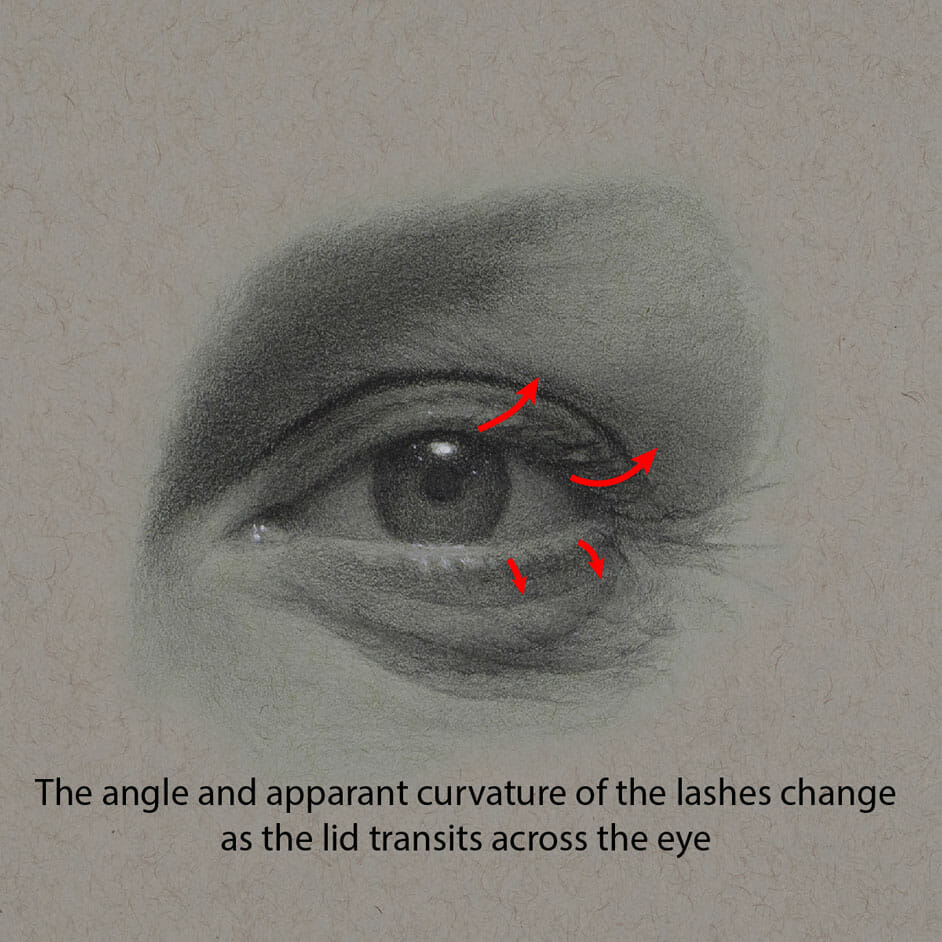
It's likewise important to consider the orientation of the eyelashes equally they protrude from the edge of each lid. Remember, the eyeball is curved, and the eyelids along with them. Eyelashes almost e'er projection outward from the eye, roughly perpendicular to the surface of the eyeball. So, lashes that are prepare in the heart of the eyelid volition project roughly forward. But as the eyelid wraps around the eyeball, its surface changes orientation. Approaching the lateral corner of the eye, the lashes will appear to project somewhat sideways, but still perpendicular to the surface of the eyeball (or close).
Curvature
Eyelashes are never straight, merely curved. The trajectory of the upper lashes projects outward from the lesser border of the eyelid, but and so curves gently upwards toward the tips. This effect is even more pronounced if your model is wearing mascara or fake eyelashes, in which case the curved sweep of the lashes will be unmistakeable.
Highlights
Highlights are just tiny reflections of the light source bounced off the surface of a form. They're not always clearly visible, but when they are, it's ordinarily on polish, glossy surfaces… similar an eyeball.
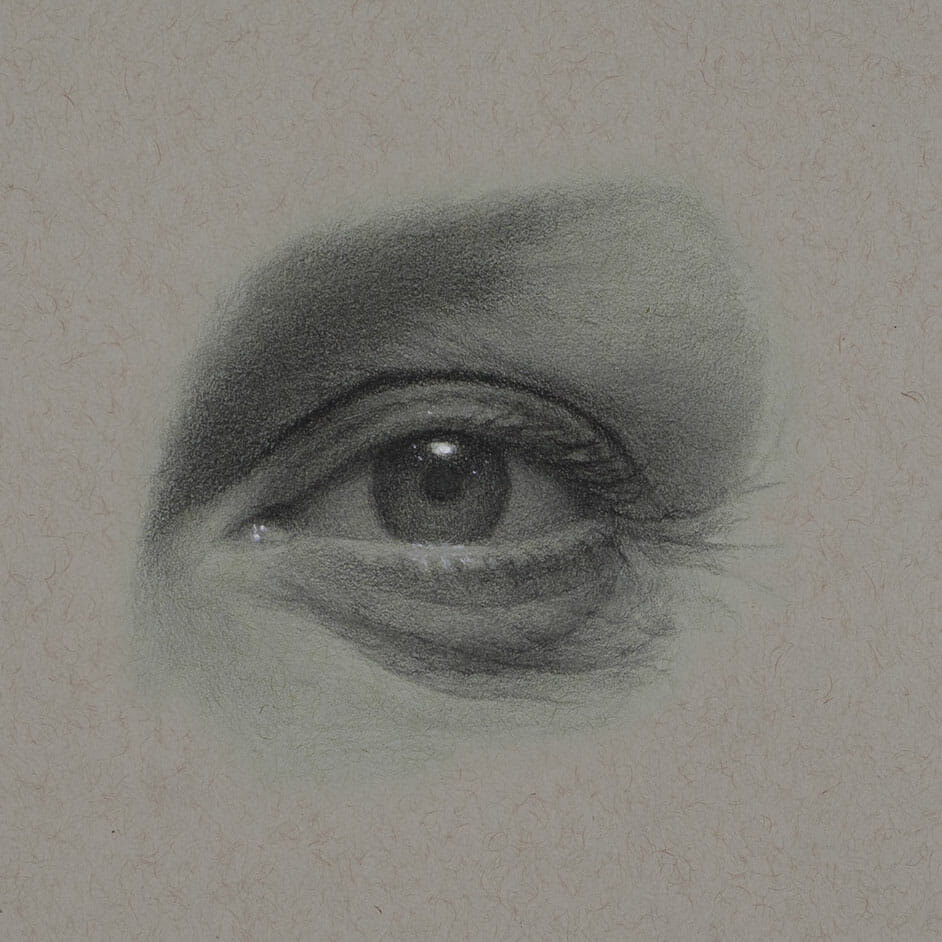
A highlight will be visible on the eyeball when the incident rays from the light source bounce off its surface at but the right angle toward the eye of the viewer. In this case, there is a pretty strong highlight just higher up the pupil. Simply at that place are other, smaller, dimmer highlights to be seen in on the slick surfaces of the inner canthus and forth the elevation of the lower hat where it meets the moisture surface of the eyeball.
Depending on how bright the highlights are, and the value of your newspaper, you may find it necessary to use some white chalk to go the right value. In this case, because the surrounding value of the iris is then night, I began by erasing whatsoever graphite in the area starting time, then applied chalk opaquely with a sharp General'south Charcoal White pencil. The other, dimmer highlights were also applied with the chalk pencil, but less opaquely.
Other Details
At this point, you may exist washed drawing the center. Including surface details similar wrinkles and pores in the skin often isn't necessary, and can even detract from your drawing if they're mishandled.
If you practice choose to pursue this level of description, be aware that many of the wrinkles or "crows feet" nosotros come across effectually the eye are set perpendicular to to the muscle fibers of the Orbicularis Oculi, which travel around the center region in concentric circles. When these muscle fibers contract, they crusade the the eye to scrunch up – similar the draw string in a hoodie – causing wrinkles to radiate outward, cutting beyond their circular path.
The skin under the eye, between the lower lid and the infraorbital furrow, is quite soft and sensitive. It tin can prove variations in color, such as redness or subtle violet tones. Equally we age, this area can likewise be a locus of small-scale wrinkles equally sagging skin collects above the rigid bottom edge of the eye socket.
If you cull to draw those wrinkles equally I did, but remember that minor features on the skin are forms, just similar the larger ones, and every form has a light side and a night side. Students oft get astray when drawing wrinkles past focusing too much on the grooves in the skin, drawing them every bit lines on the folio. But it's important to remember that most texture we might endeavor to describe – including on the skin – is simply an organization of peaks and valleys.
Those grooves we run into in wrinkles are depressions in the surface – little ruts and ravines that run between an arrangement of puckering fullnesses that project outward, each catching the light in its own style. These small only total forms between the wrinkles are what yous want to focus on, describing the lite side and night side of each. Do that inside an advisable range of values, and the "wrinkles" will almost draw themselves.
Conclusion
For as much information as I've included in this post, it'southward yet non comprehensive. There's a huge variety of human faces out there, and anybody'south eyes are a trivial bit dissimilar. Add to that different perspectives and lighting weather condition, and there is just no single arroyo to drawing eyes that is correct or complete.
Ultimately, the best way to describe better eyes is to depict lots of them – practice is the key to honing any skill, including drawing. So I hope you detect the information presented here helpful as y'all piece of work to develop your drawing skills.

How To Draw A Star With Cute Eyes,
Source: https://vitruvianstudio.com/how-to-draw-better-eyes/
Posted by: lightreand1997.blogspot.com
0 Response to "How To Draw A Star With Cute Eyes"
Post a Comment