

How Do You Resource A Menu Template
This browser is no longer supported.
Upgrade to Microsoft Edge to have advantage of the latest features, security updates, and technical back up.
Tutorial: Create and deploy your starting time ARM template
This tutorial introduces you lot to Azure Resource Director templates (ARM templates). It shows you how to create a starter template and deploy it to Azure. You'll acquire nigh the construction of the template and the tools yous'll need for working with templates. It takes about 12 minutes to complete this tutorial, but the actual fourth dimension will vary based on how many tools yous need to install.
This tutorial is the first of a series. Every bit you progress through the series, you lot modify the starting template step by step until you lot've explored all of the core parts of an ARM template. These elements are the edifice blocks for much more than complex templates. We promise by the terminate of the series yous're confident creating your own templates and ready to automate your deployments with templates.
If you want to larn about the benefits of using templates and why you lot should automate deployment with templates, run into ARM template overview. To learn about ARM templates through a guided prepare of modules on Microsoft Acquire, see Deploy and manage resource in Azure past using ARM templates.
If y'all don't have an Azure subscription, create a free business relationship before y'all begin.
Tip
If yous're new to ARM templates, you lot might consider learning Bicep instead. Bicep is a new language that offers the same capabilities as ARM templates just with a syntax that's easier to use. To start learning Bicep, run into Quickstart: Create Bicep files with Visual Studio Lawmaking.
Let'southward start by making sure you have the tools you demand to create and deploy templates. Install these tools on your local machine.
Editor
Templates are JSON files. To create templates, yous need a expert JSON editor. We recommend Visual Studio Code with the Resources Managing director Tools extension. If yous demand to install these tools, see Quickstart: Create ARM templates with Visual Studio Code.
Command-line deployment
You likewise need either Azure PowerShell or Azure CLI to deploy the template. If you utilise Azure CLI, you lot must accept the latest version. For the installation instructions, encounter:
- Install Azure PowerShell
- Install Azure CLI on Windows
- Install Azure CLI on Linux
- Install Azure CLI on macOS
Subsequently installing either Azure PowerShell or Azure CLI, brand certain you sign in for the showtime time. For help, see Sign in - PowerShell or Sign in - Azure CLI.
Important
If you lot're using Azure CLI, make sure y'all accept version 2.6 or later. The commands shown in this tutorial will not work if you're using earlier versions. To check your installed version, use: az --version.
Okay, y'all're ready to offset learning about templates.
Create your first template
-
Open Visual Studio Code with the Resources Manager Tools extension installed.
-
From the File menu, select New File to create a new file.
-
From the File menu, select Save as.
-
Name the file azuredeploy and select the json file extension. The complete name of the file is azuredeploy.json.
-
Relieve the file to your workstation. Select a path that is easy to remember considering you'll provide that path later when deploying the template.
-
Copy and paste the following JSON into the file:
{ "$schema": "https://schema.management.azure.com/schemas/2019-04-01/deploymentTemplate.json#", "contentVersion": "one.0.0.0", "resources": [] }Here's what your Visual Studio Lawmaking surround looks like:
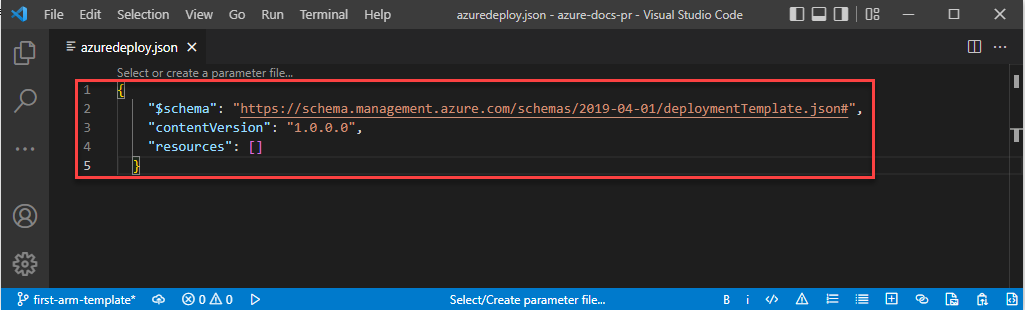
This template doesn't deploy whatsoever resource. We're starting with a bare template so y'all can get familiar with the steps to deploy a template while minimizing the chance of something going wrong.
The JSON file has these elements:
-
$schema: Specifies the location of the JSON schema file. The schema file describes the properties that are available within a template. For example, the schema definesresourcesevery bit 1 of the valid properties for a template. Don't worry that the date for the schema is 2019-04-01. This schema version is upwardly to engagement and includes all of the latest features. The schema date hasn't been changed considering in that location have been no breaking changes since its introduction. -
contentVersion: Specifies the version of the template (such equally 1.0.0.0). You can provide any value for this chemical element. Use this value to document significant changes in your template. When deploying resources using the template, this value can be used to make sure that the correct template is beingness used. -
resource: Contains the resources you lot want to deploy or update. Currently, it's empty, just you'll add resource later.
-
-
Save the file.
Congratulations, you've created your first template.
Sign in to Azure
To offset working with Azure PowerShell/Azure CLI, sign in with your Azure credentials.
Select the tabs in the following code sections to choose between Azure PowerShell and Azure CLI. The CLI examples in this article are written for the Bash crush.
- PowerShell
- Azure CLI
Connect-AzAccount If you have multiple Azure subscriptions, select the subscription yous want to utilise. Supervene upon SubscriptionName with your subscription name. Y'all tin also use the subscription ID instead of the subscription proper noun.
- PowerShell
- Azure CLI
Set-AzContext SubscriptionName Create resource group
When y'all deploy a template, you specify a resource group that will contain the resources. Before running the deployment command, create the resources grouping with either Azure CLI or Azure PowerShell.
- PowerShell
- Azure CLI
New-AzResourceGroup ` -Name myResourceGroup ` -Location "Key Us" Deploy template
To deploy the template, use either Azure CLI or Azure PowerShell. Use the resource group you created. Requite a name to the deployment so you lot can easily identify it in the deployment history. For convenience, also create a variable that stores the path to the template file. This variable makes information technology easier for you to run the deployment commands because you don't have to retype the path every fourth dimension you deploy. Replace {provide-the-path-to-the-template-file} and the curly braces {} with the path to your template file.
- PowerShell
- Azure CLI
$templateFile = "{provide-the-path-to-the-template-file}" New-AzResourceGroupDeployment ` -Name blanktemplate ` -ResourceGroupName myResourceGroup ` -TemplateFile $templateFile The deployment control returns results. Wait for ProvisioningState to meet whether the deployment succeeded.
- PowerShell
- Azure CLI
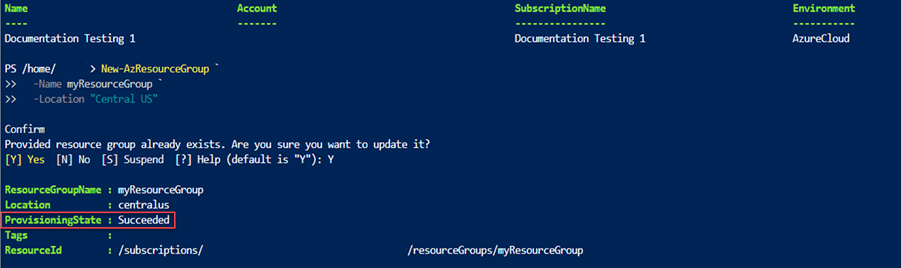

Note
If the deployment failed, use the verbose switch to get information most the resources being created. Utilize the debug switch to go more information for debugging.
Verify deployment
You can verify the deployment by exploring the resource grouping from the Azure portal.
-
Sign in to the Azure portal.
-
From the left menu, select Resource groups.
-
Select the resource grouping deploy in the concluding process. The default name is myResourceGroup. You lot shall see no resource deployed inside the resources grouping.
-
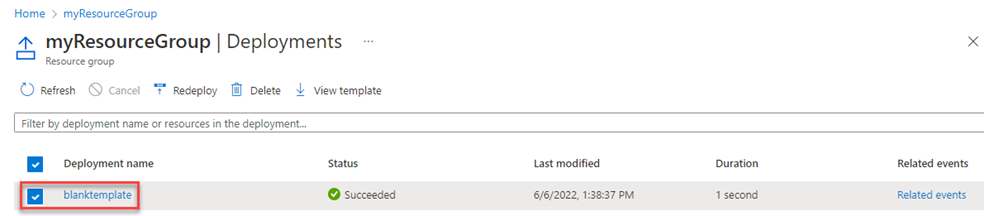
Discover in the upper right of the overview, the status of the deployment is displayed. Select one Succeeded.

-
You see a history of deployment for the resource group. Select blanktemplate.
-
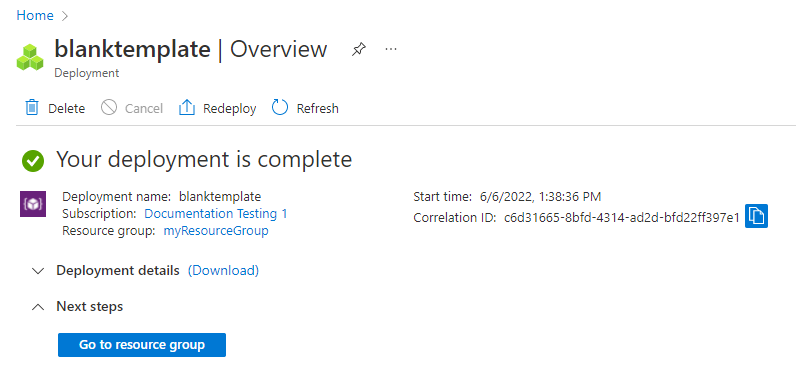
Y'all meet a summary of the deployment. In this instance, there's not a lot to encounter because no resources were deployed. Later in this series y'all might find it helpful to review the summary in the deployment history. Notice on the left y'all can view inputs, outputs, and the template used during deployment.
Clean up resource
If y'all're moving on to the next tutorial, you don't need to delete the resource group.
If you're stopping now, y'all might want to delete the resource group.
- From the Azure portal, select Resource group from the left menu.
- Enter the resource group name in the Filter by name field.
- Select the resource group name.
- Select Delete resource group from the top menu.
Next steps
You lot created a simple template to deploy to Azure. In the adjacent tutorial, yous'll add a storage account to the template and deploy it to your resource grouping.
Feedback
Submit and view feedback for

How Do You Resource A Menu Template,
Source: https://docs.microsoft.com/en-us/azure/azure-resource-manager/templates/template-tutorial-create-first-template
Posted by: lightreand1997.blogspot.com
0 Response to "How Do You Resource A Menu Template"
Post a Comment